Appa-go-witch
The Ute tüvasa (now generically referred to in English as a Two-Spirit person) named Appa-go-witch of Ouray, Utah, was born in 1879. They were the youngest of six known children of Quinkent (or Quinket), who later became known as Chief Douglas, and an unknown mother. They were members of the White River Band of Utes. Appa-go-witch was born the same year that their father was involved in the so-called White River War (also known as the Meeker Massacre) on September 29 in western Colorado. An Indian Bureau family record of Appa-go-witch, created circa 1930, extraordinarily reports that their sex was “½ M & ½ F Dresses as woman.”
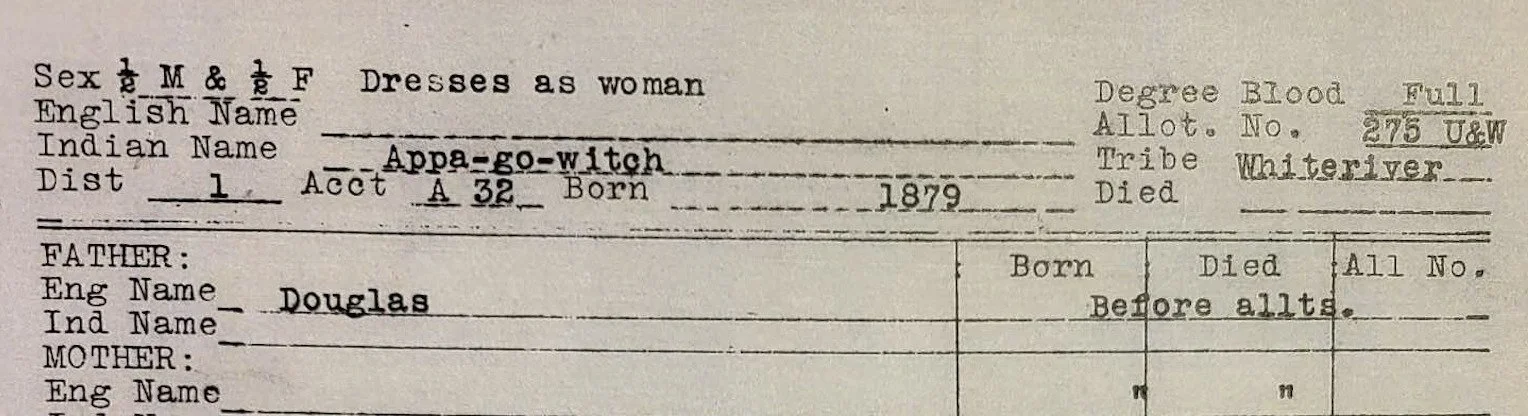
Detail of Indian Bureau family file, circa 1930. Image courtesy of Shelby Chapoose and the Utah Historical Society.
In the spring of 1922, Appa-go-witch attended the annual Bear Dance, held at Dragon, Utah. A photograph was taken of Appa-go-witch in a long skirt, plaid shawl, and sun bonnet dancing with Luke Shook, smiling brightly into the camera.

Appa-go-witch and Luke Shook, Bear Dance, 1922. Image courtesy of Shelby Chapoose and the Utah Historical Society.
Appa-go-witch died two days after Christmas 1955. When mortician Joseph E. “Ted” Olpin of Olpin Mortuary in Roosevelt retrieved their body, “he discovered the supposed woman, who was wearing the attire of a woman, was not female at all, but definitely was a male member of the tribe.” Except for immediate family members, everyone else “considered the 76-year-old Ute Indian to be of the feminine sex,” and had always worn women’s clothing. Even tribal records at Fort Duchesne listed them as a woman. The death notice also reports that when they were buried at the White Rocks Cemetery, “curiously enough – Mr. Appa-Go-Witch was buried in women’s clothes.” Another account published two weeks later, reported this “curious habit of the Utes” in burying Appa-go-witch in women’s clothing “was due to the insistence of other members of the tribe,” indicating that this was an important tribal tradition.
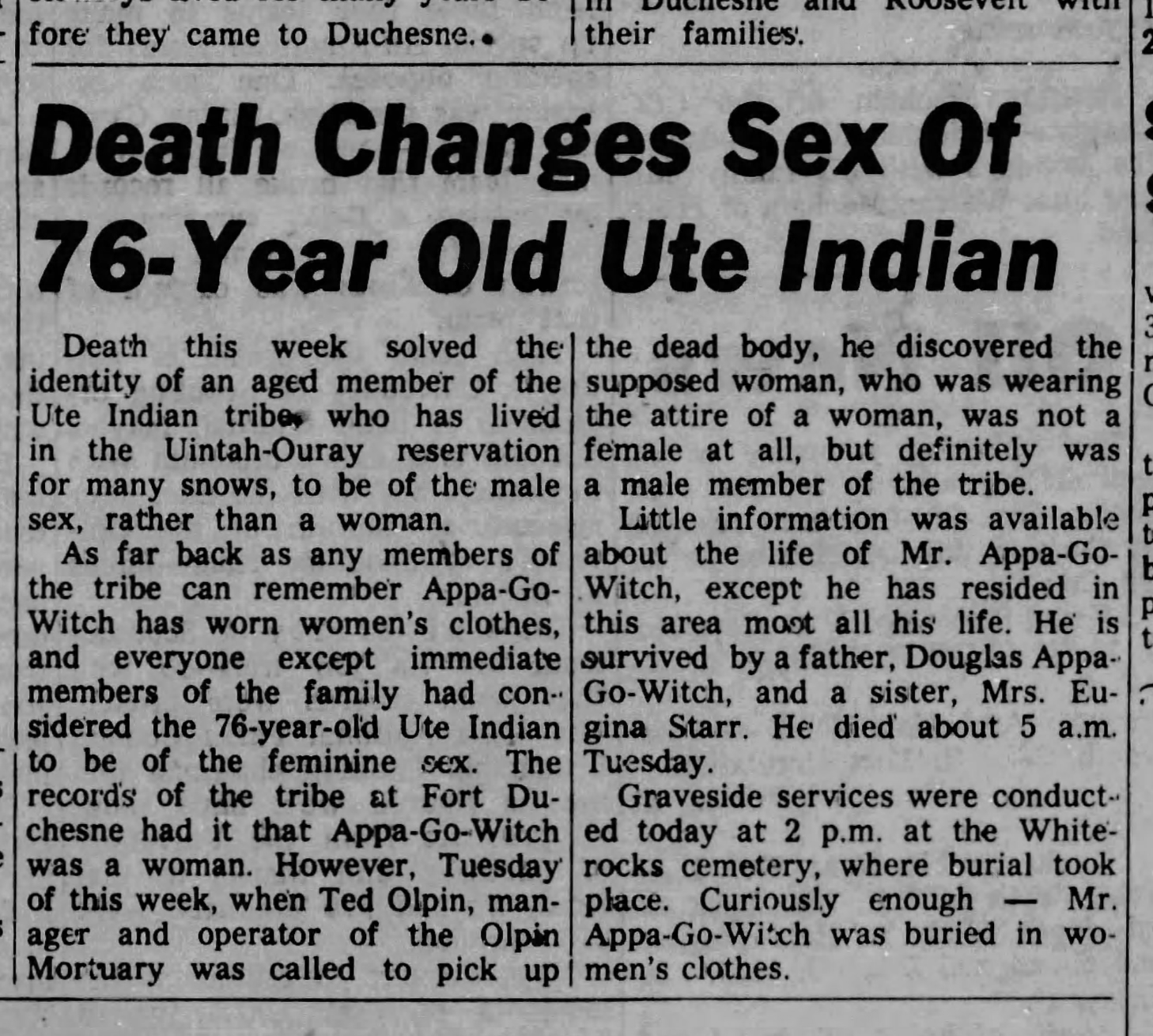
Image Courtesy Utah Digital Newspapers.