Note that archaic and offensive language is herein used when quoting others. Our understanding of sex and gender has greatly improved in the past 50 years, and of course, there is always room for improvement in the future.
In October 1971, Kim Foltz (a Gay man who was Entertainment Editor for the U of U campus paper, the Utah Daily Chronicle) published an article about Dr. Clifford C. Snyder and his performing "sex change operations" at the U Medical Center since at least 1967. These were mainly for patients who were believed to be intersex - those born with sex characteristics that do not fit into typical binary ideas of "male" or "female" bodies. Some current estimates are that 1 in every 2,000 people are born intersex. But in 1971, Dr. Snyder reported 1 in every 7,000.
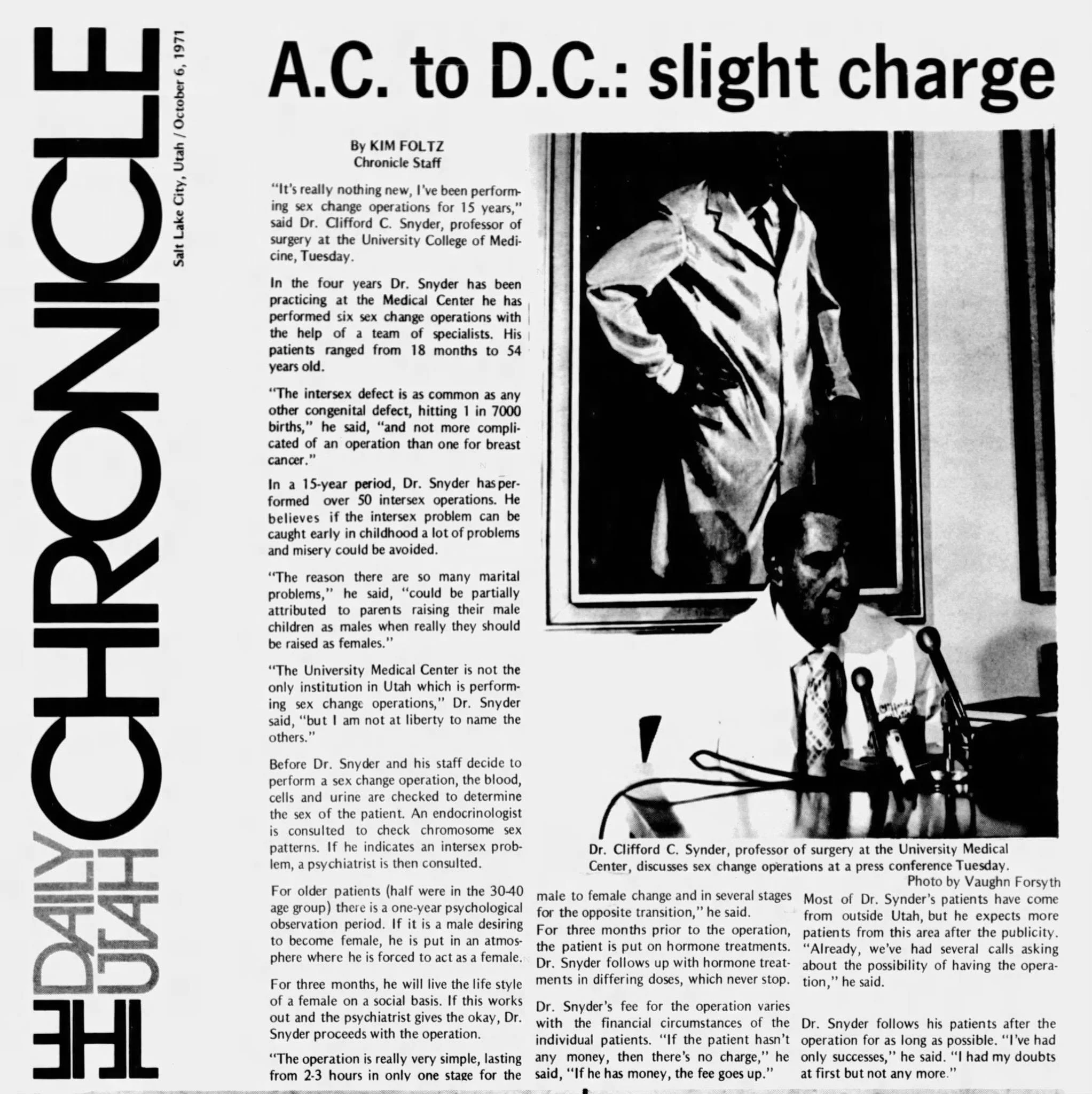
Originally from Texas, Snyder served during World War II as a Navy surgeon. He began performing "sex change operations" for intersex people about 1956, and he continued to do so when he became a Professor of Surgery and the Chair of the Division of Plastic Surgery at the University of Utah School of Medicine in 1967. He likely continued to perform such surgeries at the University Medical Center until his retirement. He died here in SLC in 2007.
In this article, Snyder acknowledged that in his four years at the U's Medical Center, he had performed six “sex change operations” for patients ranging from 18 months to 54 years old. These plastic surgeries were performed for people determined to be intersex by using blood cells, urine, and an endocrinological consultation. If the endocrinologist “indicates an intersex problem, a psychiatrist is then consulted.” If the person in question is old enough, they were psychologically observed for a year, “forced to act” as the “correct” sex, and placed on appropriate hormones for three months before the surgery. The cost of these operations by Dr. Snyder were on a sliding scale – “If the patient hasn’t any money, then there’s no charge.”
While he indicated that the U’s Medical Center was not the only institution in Utah performing such surgeries for intersex individuals, Snyder would not divulge which ones. Most of Dr. Snyder’s patients had been from out of state, but after this publicity, he expected to get more local patients. After his surgeries, he followed his patients “for as long as possible," and prided himself in having “only successes.”
You might remember Dr. Snyder from 1979 when he was the first surgeon in the world to successfully separate twins conjoined at the head - Lisa and Elisa Hansen from Layton, Utah.