Bare Ass Beach, 1982
When Visibility Became the Crime
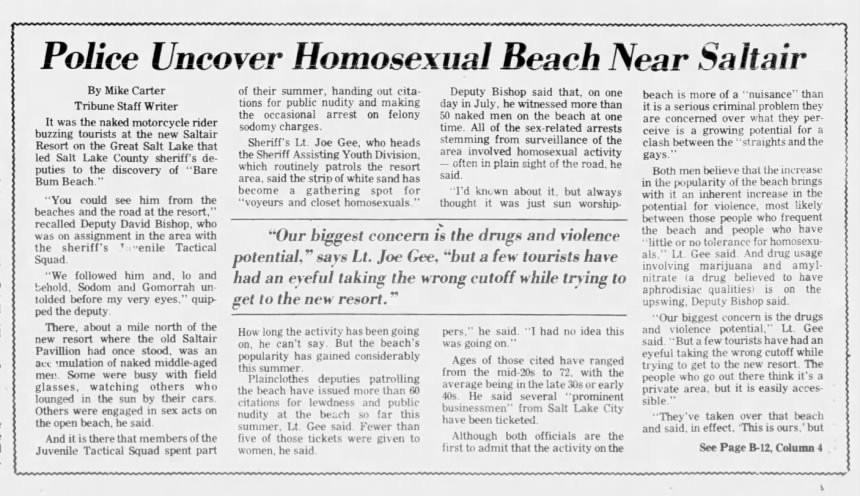
During the summer of 1982, a Salt Lake County sheriff followed a nude motorcyclist along I-80 to a remote shoreline of the Great Salt Lake. What he reported finding, he told The Salt Lake Tribune, was “Sodom and Gomorrah.” What he had stumbled upon was known to local nudists, voyeurs, gays, and lesbians as Bare Ass Beach. Officers returned throughout the summer, issuing citations for public indecency and making arrests for sodomy. More than sixty people were cited, almost all of them men, and all of the sex-related arrests involved homosexual activity.
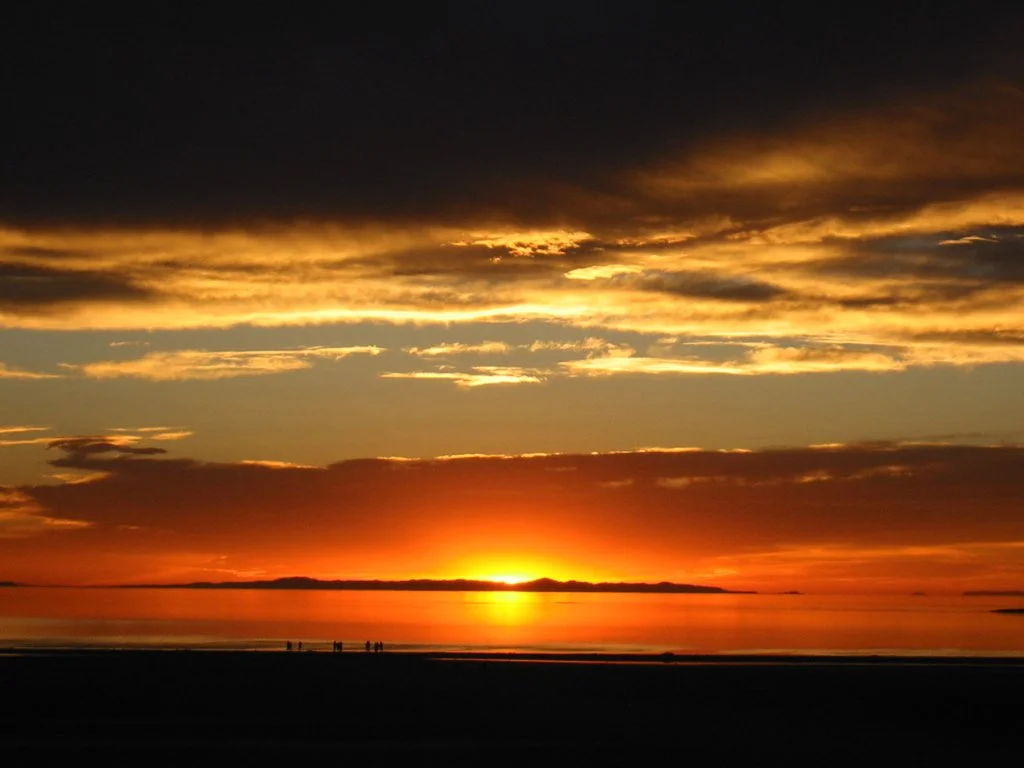
Sunset over Great Salt Lake. Image courtesy Wikimedia
At first glance, the crackdown looked like a straightforward enforcement of public decency laws. But the officers’ own explanations tell a different story. They admitted the beachgoers were not a serious threat but rather a nuisance. Their greater concern was the possibility of violence. Without evidence or a clear pattern of such incidents, officers suggested that others might attack the gay men who gathered there. In this framing, queer visibility itself became the problem.
In reality, Bare Ass Beach had been a known gathering place for over a decade. It offered something rare in Utah at the time: a space, however hidden, where queer people could exist more openly. In fact, Bare Ass Beach was the site of the first Pride event in 1974, purposefully called a “beer kegger” to avoid using the terms “gay” and “lesbian” in advertisements.2 By the 1980s, arrests under sodomy laws were already declining for consenting adults, increasingly focused instead on cases involving minors. Police instead leaned on vague indecency statutes and ongoing surveillance to monitor and control these spaces, even as they called for harsher, more clearly defined laws to target homosexual behavior.
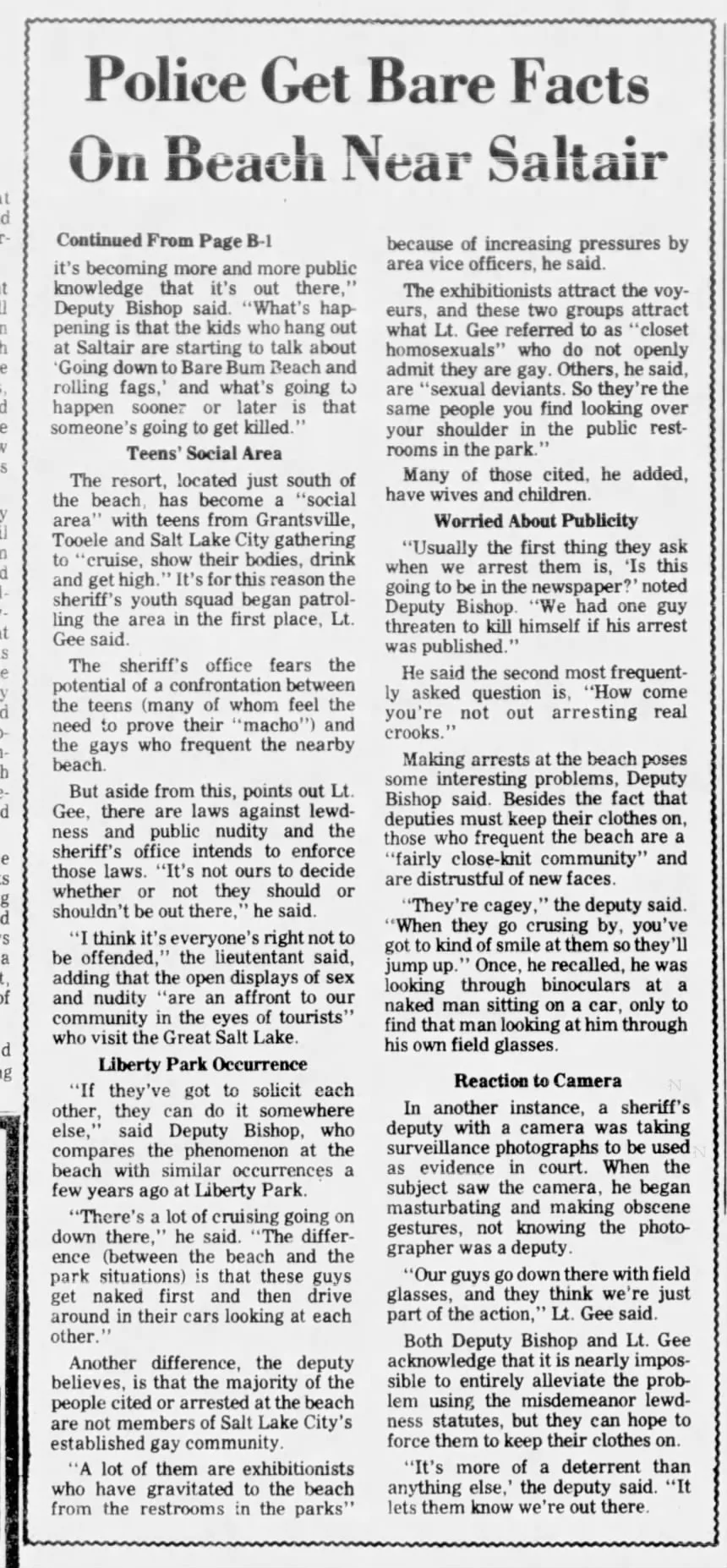
As one deputy put it, enforcement was “more of a deterrent than anything else… It lets them know we’re out there.” Policing Bare Ass Beach was about more than monitoring illegal acts, it was about enforcing social norms. In practice, that meant treating queer presence itself as something to be watched, managed, and pushed back into the shadows. As sodomy laws faded as a tool for arresting gay men by the late 1960s and a more visible gay and lesbian community emerged by the late 1970s, Utah lawmakers struggled to respond and produced laws that were often short-lived, quickly overturned, or simply ineffective.
Sources
Mike Carter, “Police Uncover Homosexual Beach Near Saltair,” The Salt Lake Tribune (Salt Lake City, Utah), 6 September 1982, p. 17, 28.
Hoffman, Randell. “Joseph Willis Redburn: Forgotten Leader and Father of LGBTQ+ Utah.” YouTube video, 1:10:33. 9 October 2025. https://www.youtube.com/watch?v=dBJsU7Kq0I8.
Wayne A. Bateman, “Gayest Column: Police, Media Exploit Bare Facts of Nude Beach,” The Daily Utah Chronicle (Salt Lake City, Utah) 18 October 1982, p. 5